Machine Learning for Electronic Warfare
Part of the Field Guide to Cognitive Electronic Warfare. All information is derived from unclassified, publicly releasable sources.
Machine learning is what makes cognitive electronic warfare possible, but the mainstream method does not transfer. General-purpose machine learning learns from abundance: many labeled examples, offline, with time to iterate. Electronic warfare's defining case is the opposite: a threat with no dataset, one brief observation, and a decision due in seconds, against an adversary that adapts in response. This page covers the three parts of machine learning as the field actually needs it: the training-data problem and the discipline of recognizing the unfamiliar, in-mission learning that converts one observation into a better action safely, and the RF foundation models that arrive already knowing radio so that one observation is enough.
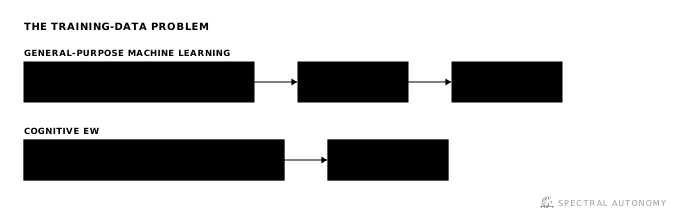
The training-data problem
Most visible results in machine learning rest on a large, labeled dataset. The method gathers many examples of each item to be recognized, trains a model until it generalizes, and applies it to more of the same. This works when the conditions at deployment resemble the conditions at training. It is the wrong approach for a problem whose defining case is the one that resembles nothing seen before, and a cognitive EW system built as though data were abundant will fail exactly when it is needed.
Three factors keep the data away. The threats that decide engagements are novel, so no record of them exists. The adversary keeps its most capable systems off the air in peacetime, so they are absent from any training set on the first day of a conflict. And the environment is large and shifting, so even known emitters appear under conditions never fully sampled. A cognitive EW system therefore cannot assume it has seen the signal in front of it. It has to be built to handle the case it was never shown, which is a design premise rather than a feature added later.
One failure mode makes the problem concrete, and it is dangerous because it gives no warning. A model trained to sort signals into a fixed set of known classes will sort every signal into one of them, often with high confidence, because it has no representation for none of the above. Presented with a genuinely new emitter, it does not raise a flag. It returns a confident, incorrect label, and a confident incorrect label on the threat that matters is worse than no label, because it tells the rest of the system to relax. Recognizing the unfamiliar is a different task from recognizing the familiar, and a system that performs only the second is blind where blindness costs most.
The required capability is the ability to determine that an input is unlike anything in the system's experience, to set it apart rather than force it into a known category, and to characterize it from the little available. This is the problem of open-set recognition: a classifier that can reject an input as unknown, rather than assign it a known label, and can do so with few or no prior examples of the unknown class. It is the front line of the sensing problem, because a system that flags what it has not seen can at least respond to it, while a system that cannot will pass it by. Having flagged a new emitter, the system still has to construct a response from the single observation it was given, while the engagement continues — which is the next problem.
In-mission learning
Learning after a system is fielded, during the engagement itself, is the capability that separates a cognitive EW system from a well-built automated one, and it is the hardest requirement in the field. A system that learned only before deployment is an automated system with a good memory. It can be excellent against everything it was trained on and helpless against what it was not, and what it was not is what the engagement will present. This is why a demonstration against known threats proves little; the distance from that demonstration to a fielded capability, treated in Testing, Trust, and Fielding Cognitive EW, is largely the question of whether the system can learn once it leaves the laboratory.
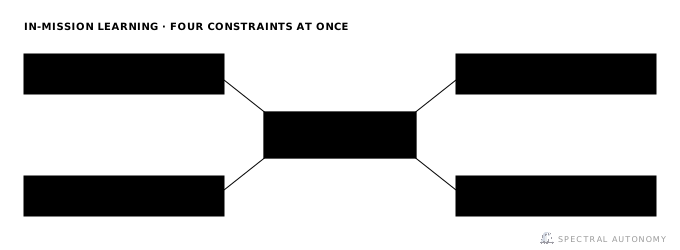
The case that matters provides one observation. A new emitter appears, a decision is due in seconds, and there is no dataset and no time to assemble one. This excludes the methods that dominate machine learning elsewhere, which require many examples and repeated iteration. What remains is a system that arrives already knowing a great deal, so that a single observation moves it a long way. In practice that means strong prior knowledge and the ability to adapt from very little, so that one example is enough to act on rather than only to notice. The design target is not a larger model trained on more data. It is a system that does the most with the least, because the least is what the engagement provides.
Exploration is constrained at the same time. In most machine learning a poor exploratory action costs a little accuracy, so systems are free to try options and observe the outcome. In electronic warfare a poor exploratory action can cost the platform. A system that learns by trying a countermeasure it is unsure of reveals itself and may fail to defend against a live threat in that moment. It cannot experiment on a hostile radar the way a recommendation system experiments on a web page. Building a learner that improves quickly while never taking a step that could be fatal is a different problem from ordinary trial-and-error learning, and safety here is part of the learning problem rather than a constraint added to it.
A further difficulty separates this from a hard but static learning problem: the subject of the learning changes because it is being acted upon. The adversary adapts to what the system does, so a lesson learned a minute ago may already be obsolete, and a technique that worked becomes an example the adversary can learn to defeat. A learner built on the assumption that conditions hold still will be wrong in a way it cannot detect. What is required is a system that expects conditions to change, detects when they have, and re-adapts, which is closer to holding a position in a contest than to solving a fixed problem. And all of it occurs where the engagement is: the loop runs in seconds, the link to a rear site may be jammed, so the fast learning runs on the platform, within its power and cooling.
Foundation models for RF
The method that produced modern language and image systems has reached the radio-frequency domain, and it is the most consequential change in how machines are taught about radio. For most of machine learning's history a model was built for one task from data labeled for that task. That changed with the pretrain-and-adapt method. A model is trained on large amounts of unlabeled data with no particular task in mind, acquiring the structure of the domain, and is then adapted to specific tasks with much less labeled data. The pretrained model supplies general knowledge that makes each specific task easier.
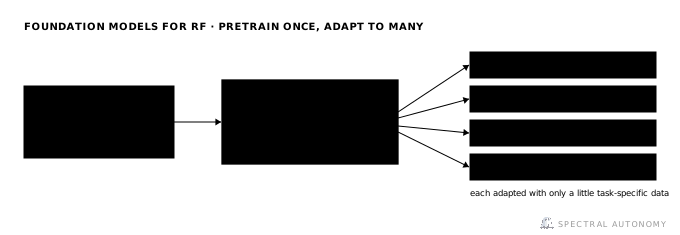
Applied to the spectrum, the method produces a model that represents radio in general: the regularities of how emitters behave, how channels distort them, and how modulations and timings are structured, learned without being told in advance what any of it is. The significance is not any single model. It is that the base of the field shifts from hand-built detectors for known signals toward general models that can be adapted to many problems, including detection, identification, and the estimation of state and effect described in Electronic Support and Battle Damage Assessment.
The value for cognitive EW follows from the training-data problem. A model that already represents radio in general requires far fewer examples of any specific new threat, because it adapts existing knowledge rather than learning from nothing. Against a domain defined by scarce data, that is the most useful property a method can have. It does not remove the scarcity, and it does not produce examples of a threat never seen, but it lowers how much a system must be told about each new thing, which is what the field requires.
These models extend recognition and estimation; they are not judgment and they are not guarantees. A model that represents radio in general can still be confidently wrong about a signal outside its experience, inherits the limits of the data it was trained on, and produces outputs that must be verified before they are trusted. The same generality that lets such a model recognize a signal also lets it generate one, a capability with its own use and its own risk, and the model is itself a target for an adversary that wants to mislead it. Both consequences are the subject of Electronic Attack, Protection, and Cognitive Radar. The method is powerful and unfinished, and it should not be trusted on capability alone.
FAQ
- Why can't cognitive EW use the same machine learning as everyone else?
- Because the case that matters has almost no data. The threats that decide engagements are novel, an adversary withholds its best systems, and the first observation may be the only one, so data-rich methods do not apply.
- What is open-set recognition and why does it matter?
- The ability to determine that a signal is unfamiliar and set it apart, rather than forcing it into a known category. A classifier without it assigns new threats a confident, incorrect label, which hides exactly the threat that matters.
- What is in-mission learning?
- Improving during the engagement, from what the system observes in the engagement, rather than only from data trained on beforehand. It is the capability that makes a system cognitive rather than automated.
- What makes in-mission learning uniquely difficult?
- Exploration can be fatal, and the adversary changes in response to what the system does. The learner must be fast, safe, and robust to a moving target at the same time, on platform power.
- What is a foundation model for RF?
- A large model pretrained on unlabeled radio data, which learns the general structure of signals and can then be adapted to specific tasks such as detection or identification with far less task-specific data.
- Do foundation models solve the data problem?
- They relieve it. A model that already represents radio needs fewer examples of any new threat, but it can still be confidently wrong outside its experience, so its outputs must be verified and assured.