Electronic Support and Battle Damage Assessment
Part of the Field Guide to Cognitive Electronic Warfare. All information is derived from unclassified, publicly releasable sources.
Cognitive electronic warfare runs on two measurements. Electronic support measures the environment: what is emitting, what it is, where it is, and what it is doing. Battle damage assessment measures the effect: whether the last action degraded its target. Neither can be read directly. The environmental picture is always partial, and the effect is inside a hostile system that does not report its state, so both are inference under an adversary. One constraint follows and bounds the whole field: a cognitive EW system can act only on what it can measure. This page develops that constraint, then the two functions that live under it.

The measurement constraint
A cognitive EW decision reduces to a comparison. The system reads its situation, evaluates the settings it can change, and selects those it expects to score best. A single number is used because comparison requires one axis. That number encodes the operator's intent, which usually balances several goals: degrade the threat, remain difficult to detect, and avoid denying the spectrum to friendly systems. Assigning those relative weights is a design decision. None of it is what makes electronic warfare distinct.
What makes it distinct is that the most important term in the score cannot be read from any instrument the system owns. A jammer knows its own transmitted power to the watt. It does not know whether the target radar lost its track, switched to a mode that ignores the interference, or was unaffected. That information is inside the hostile system, which does not report its state. The system can observe only the target's later behaviour and reason backward, and reasoning backward from behaviour is inference, which is weaker and less reliable than measurement.
Where an effect can be inferred, the inference is time-sensitive. Feedback arrives on different timescales. A communications link's success or failure is apparent within moments. A change in a tracking radar's behaviour may take many sweeps to confirm. Whether a mission succeeded may not be known for hours. As the delay grows, attributing an effect to the action that caused it becomes harder, because the situation changes in the interval and other events intervene. A fast, approximate estimate of effect is often more useful than a slow, precise one, because it arrives while the action can still be credited and, if it failed, changed.
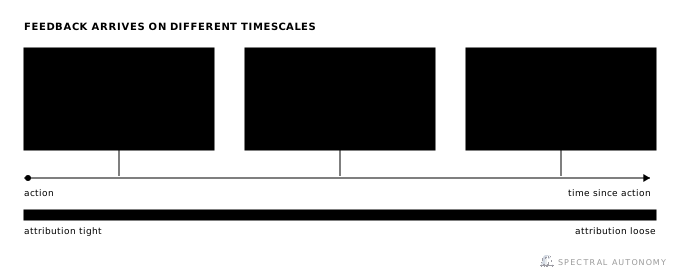
The consequence is a discipline. Optimize the truest measure of success that can be obtained within the window in which it still matters, and account for how that measure differs from the true objective. A practical system begins with the simplest quantity that can be read quickly and reliably, uses it to exercise the decision loop, and adds richer measures as the system stabilizes. The measure must be tied to the goal by cause and not only by correlation, because a system optimizes exactly what it is told to measure, and a proxy that diverges from the goal will be pursued while the mission fails. Selecting these proxies is the central engineering task, not a preliminary to it.
The boundary of what can be measured is not fixed. Much of what a system needs is not read directly but estimated by a model from indirect evidence, and a better model moves the boundary outward. Large models trained on raw radio can estimate an emitter's state, or an action's effect, from faint over-the-air evidence that conventional signal processing cannot convert into a usable value. The effect is to make more of the engagement measurable, and therefore optimizable. Machine Learning for Electronic Warfare describes these models.
Measurement is not one topic among several. It is the constraint the other three problems inherit: the data problem, the contest, and assurance each begin at the boundary of what can be observed. The two functions that follow are where the constraint is fought in practice.
Electronic support: from energy to intent
A receiver detects energy. A cognitive EW system requires meaning, and the distance between the two is the work of electronic support. It separates one emitter's transmissions from the rest of the activity in the band, measures the parameters that describe them, determines which known emitter they belong to or whether they belong to none, locates the emitter, and, at its most capable, estimates what the emitter is doing. Each step is a measurement or an inference built on measurements, and each carries its error forward. The system that acts is only as well informed as this function makes it.
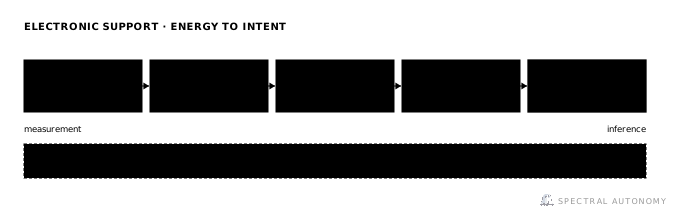
The work forms a sequence, and each step demands more than the one before. Detection establishes that energy is present. Characterization measures its frequency, timing, and modulation. Identification assigns the measurements to a type of emitter, or to a specific one. Location places the emitter and its motion. Intent estimation, the most demanding step, infers from an emitter's behaviour and its response to the system's actions whether it is searching, tracking, or preparing to engage. The lower steps are mature and largely a matter of signal processing. The higher steps are where cognition contributes, because identifying a catalogued emitter is a lookup while judging the purpose of an unfamiliar one is inference under uncertainty.
The picture is never complete. Factors that govern an emitter's behaviour, including its operator's intent, its mission, undetected hardware, and conditions no receiver can sense, lie outside what can be measured, and their absence is the main source of error in any model of the environment. This is the same partial observability that makes judging an action's effect difficult, directed at the environment rather than at the adversary. A cognitive EW system does not wait for a complete picture. It acts on an incomplete one and refines it, and designing it to act sensibly on incomplete information is a large part of the problem.
One capability illustrates how much information a signal carries. The small imperfections in a transmitter's hardware, the ways its oscillator, amplifier, and filters differ from other units of the same design, leave a faint and stable mark on everything it transmits. Reading that mark, called specific emitter identification, distinguishes one individual emitter from another of the same type, so a system can track a specific platform rather than a class. It is a measurement of something the adversary did not intend to transmit and cannot easily suppress, and it converts careful reception into a tracking advantage.
The step that matters most is the one this function performs least well on its own: the signal that matches nothing known. Determining that a signal is unfamiliar, rather than forcing it into the nearest known category, is a different task from recognizing the familiar, and it connects electronic support directly to the data problem. That task, and the methods built for it, are the subject of Machine Learning for Electronic Warfare.
Electronic warfare battle damage assessment
Every part of a cognitive EW system leads to one question: did the last action work? A cognitive EW system is a loop: understand, decide, act, and learn from the result. Battle damage assessment is the step that closes the loop rather than leaving it open. Without a judgment of effect the system has acted without feedback. It cannot distinguish a technique that worked from one that failed, so it cannot keep the first and discard the second, so it cannot improve. Everything upstream then degrades. The response it constructs becomes a guess, and the score it optimizes becomes a value it cannot observe. A system is cognitive only to the degree that it can judge its own effect.
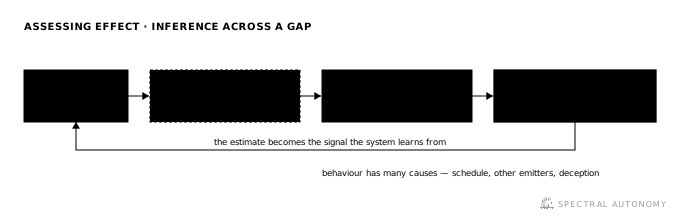
Assessing physical damage is comparatively direct, because the result can often be seen. Assessing electromagnetic effect is not, for three reasons that compound. The evidence is indirect, because the effect is inside a receiver that cannot be observed, so it is inferred from external behaviour. The target is uncooperative, because it does not report being jammed and may act to appear unaffected. And the evidence is confounded, because a threat's behaviour changes for many reasons, of which the system's action is only one. Establishing that an observed change was caused by the action, rather than by the threat's own schedule or another emitter, is a problem of separating cause from coincidence under an adversary.
Because the internal state is hidden, the system works from external indications. A radar that was tracking and now searches, a link that reduced its data rate, an emitter that changed mode or fell silent, each indicates that an effect may have occurred, and none is conclusive alone. The system combines these indications, weighs them against what the threat was expected to do regardless, and produces an estimate with an attached confidence rather than a verdict. Carrying that uncertainty forward matters as much as the estimate, because a system that is confidently wrong about its effect will learn confidently wrong lessons.
The feedback channel is itself a target, which ordinary control problems do not face. An adversary that recognizes it is being assessed can supply false evidence, appearing unaffected to make a successful countermeasure look ineffective, or concealing a real effect to hide that a vulnerability was found. The signal a cognitive system learns from can be corrupted by the opponent it is learning about, so assessing effect and defending that assessment cannot be separated. Electronic Attack, Protection, and Cognitive Radar follows this.
Timing compounds both difficulties. Because the loop runs within the engagement, an assessment that is accurate but late has no value; the timescale trade described in the measurement constraint is at its sharpest here. Assessment is produced quickly, with its uncertainty stated, and revised as more evidence arrives, and the models that matter most are the ones that estimate effect from faint, immediate, ambiguous evidence.
The consequence is direct. A system that cannot judge its own effect cannot learn from its own actions, and learning from its own actions is what makes it cognitive. This function sets the ceiling for the whole system, and progress on it raises the ceiling everywhere else.
FAQ
- What is electronic support?
- The sensing and understanding function of electronic warfare. It detects, characterizes, identifies, and locates signals, and at its most capable infers what an emitter is doing. It is the measurement of the environment.
- What is electronic warfare battle damage assessment?
- The judgment of whether an electromagnetic action worked, made externally against a target that does not report its own state. It is the feedback the whole cognitive system runs on.
- Why can't the effect be measured directly?
- Because it is inside the adversary's receiver, which is not observable. It can only be inferred from an ambiguous change in behaviour that has many causes besides the system's action.
- What is specific emitter identification?
- Recognizing an individual transmitter from the small, stable hardware imperfections in its signal, so a system can track a particular unit rather than a type of emitter.
- Why is cognitive EW described as bounded by measurement?
- Because a system optimizes and learns only from what it can measure, and the effect that decides an engagement cannot be measured directly. The limit is observability, and no algorithm can optimize a quantity it cannot obtain.
- Can a better sensor measure the effect directly?
- Rarely. The effect is inside the adversary's system, which does not report its state. Better models can estimate more of it from indirect evidence, but direct measurement of an opponent's internal effect is generally unavailable.