What Is Cognitive Electronic Warfare?
Part of the Field Guide to Cognitive Electronic Warfare. All information is derived from unclassified, publicly releasable sources.
Cognitive electronic warfare is electronic warfare that learns during the fight. Instead of matching a detected emitter against a library of known threats and applying a stored response, a cognitive EW system senses the spectrum, characterizes what it finds, constructs a response, judges the effect, and improves from the result, within a single engagement and with limited human involvement. The field exists because software-defined emitters broke the library method: they change waveform between transmissions and appear in forms no library holds. The capability is simple to define and difficult to build, and the difficulty has a definite structure. This page covers why the old method failed, what separates a cognitive system from the automation it is often confused with, and the four hard problems that account for the difficulty.
Why threat libraries stopped working
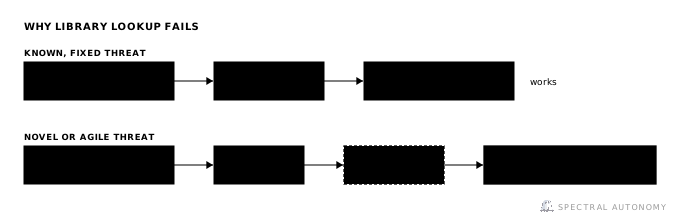
A conventional EW system is a matching system. It measures a signal's frequency, timing, and modulation, searches a stored list of threats for the nearest match, and applies the response that entry prescribes. The design assumes that the threats worth countering are known in advance, change slowly, and can be enumerated before a mission. Where that assumption holds, a lookup is the correct approach. It is fast, and it can be verified against the list it was built from.
The assumption fails when radar and radio move into software. A software-defined emitter is not fixed to one waveform. It can change frequency, reshape its pulses, switch modes, and produce behaviours that were never catalogued, between one transmission and the next. The set of signals it can produce is too large to enumerate, and the threats that matter most are the ones an adversary deliberately withholds, so they are absent from any library assembled in advance.
Adding a new threat to the library is the obvious remedy, and it is too slow. Traditional reprogramming runs on a cycle of weeks: collect the signal, analyze it, write and test an update, and distribute it. Threats change faster than that. In the war in Ukraine, the control and video links on small drones moved from fixed channels to frequency hopping, then to fiber-optic control that emits no radio to jam, then toward onboard autonomy, each change arriving before the previous countermeasure was complete. A process measured in weeks cannot hold against a threat that changes in weeks, and cannot begin to hold against one that changes in seconds.
If a response cannot be retrieved, it must be constructed, and constructing one during an engagement requires four capabilities a lookup never needed. The system must characterize a signal it may not have seen. It must decide on a response under a deadline. It must act. And it must judge whether the response worked and adjust if it did not, because a constructed response carries no guarantee. A system with these four capabilities, operating quickly and with limited human involvement, is what the field means by cognitive. The next section separates that term from the automation it is often confused with.
Adaptive, automated, and cognitive systems
The term cognitive is applied loosely to any system that reacts quickly, which obscures the distinction that matters. Three levels are worth separating, and speed distinguishes only the first two.
An adaptive system responds to its conditions with logic fixed at design time. Its action is a fixed function of what it observes: the inputs vary, the rule does not. A receiver that raises its detection threshold as the noise floor rises is adaptive, as is a jammer that selects a technique according to the emitter it detects. Such systems are frequently the correct choice. What they cannot do is handle a situation their rule did not anticipate, because they have no mechanism to form a new rule.
An automated system holds a large library of predefined responses and selects among them at machine speed. A jammer with ten thousand techniques, cycling faster than any operator, is automated, not cognitive. Every technique and the logic that selects them were fixed in advance, so the system's behaviour, however fast, is bounded by its design. Automation increases speed and scale without enlarging the set of situations the system can handle. Mistaking that speed for cognition is a common and costly error, because an automated system passes every test drawn from its own library and then fails the first case the library omits.
A cognitive system changes its own rule. It does not only compute an action from a fixed function; it revises the function from experience, in the field. This is what allows it to handle a case that was not anticipated. It can construct a response to a signal in no library, act, assess the result, and carry that result into the next encounter. The capability and the difficulty share a source. A system that revises its own logic is harder to predict, to bound, and to trust than one that cannot, which is why the freedom that makes cognition powerful is also what makes it hard to field.
The test that separates the three levels does not measure speed. Present a signal that is in no library and was not anticipated. An adaptive system applies its nearest rule and is usually wrong. An automated system finds no match and either does nothing or applies its closest entry with unwarranted confidence. A cognitive system treats the unfamiliar as unfamiliar, constructs a response, and learns from the outcome. Whether a system does something sensible with a case it was never shown is the property that distinguishes cognition.
One further distinction prevents a common confusion. Reaching the third level is not the same as adding a neural network. A system can be built almost entirely from machine learning and remain automated, if all of that learning occurred before deployment and nothing changes in the field. Cognition is marked not by the presence of a learned model but by continued learning, in the field, where learning improves the result. Machine learning is one of the tools cognition uses, alongside reasoning about a situation, planning across a mission, and managing what the system knows.
The four hard problems
Cognitive electronic warfare is simple to define and difficult to build, and the difficulty is structured. Four problems account for most of it, and the rest of this guide is organized around them.
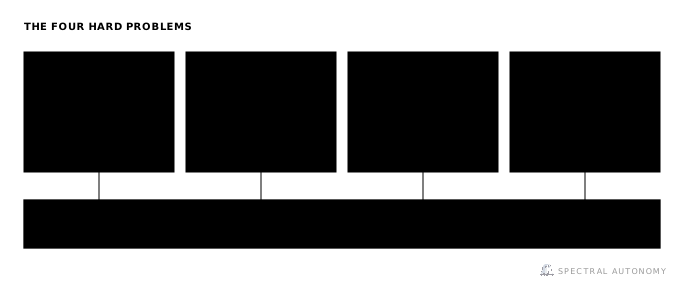
The first problem is measurement. The only evidence of an action's effect is the target's subsequent behaviour, observed from outside, and that behaviour has many causes. The effect that most needs to be known can therefore only be inferred, against an adversary that does not confirm it and may conceal it. This is the deepest of the four, and it is developed in Electronic Support and Battle Damage Assessment.
The second is data. The threats that matter are those not anticipated, and an unanticipated threat has no training set. A cognitive EW system often has one observation of a new emitter, under a deadline, and must act on it, because a second observation may not come. Learning from a single example, quickly and safely, is a different discipline from the data-rich learning used elsewhere, and it is the subject of Machine Learning for Electronic Warfare.
The third is the adversary. In most engineering the environment does not respond to the engineer. In electronic warfare it does. The score a cognitive system optimizes is a payoff in a contest, the adversary is frequently cognitive in the same sense, and a problem that changes in response to its solution has no final answer, only a faster or slower loop. Electronic Attack, Protection, and Cognitive Radar treats the contest directly.
The fourth is trust. A cognitive system produces value by changing its own behaviour, which is exactly what conventional certification cannot handle, and no commander delegates a consequential decision to a system whose behaviour cannot be bounded. Establishing that a system is safe under conditions no test anticipated is where most cognitive EW fails to progress from demonstration to fielding, as Testing, Trust, and Fielding Cognitive EW describes.
The four problems are connected by measurement. The effect cannot be judged because it cannot be measured. Abundant learning is unavailable because the examples cannot be gathered. The contest is hard because the adversary's state and the system's own effect cannot be observed. And trust cannot be established because behaviour that cannot be measured cannot be assured. The field is bounded by observability more than by algorithms, and the methods that matter most are the ones that make more of the engagement measurable.
A cognitive system is also not the correct answer to every EW problem. Where threats are known and change slowly, where a fixed rule covers the variation, and where the system can be tested once and trusted, a library or an adaptive design is both sufficient and preferable, because it is simpler and can be verified completely. A cognitive system is warranted only where one of those conditions fails: where the threats are genuinely novel, where no fixed rule keeps pace with the adaptation, or where the space of situations is too large to enumerate. Adding cognition where it is not required incurs all four problems and returns none of the benefit.
FAQ
- What is cognitive electronic warfare?
- Electronic warfare that learns within the engagement. A cognitive EW system senses the spectrum, constructs a response for the threat in front of it rather than retrieving a stored one, judges whether the response worked, and improves from the result, with limited human involvement.
- Why did library-based electronic warfare stop working?
- Because emitters became software-defined. They change waveform between transmissions and appear in forms no library holds, a lookup returns nothing for a signal with no matching entry, and the weeks-long reprogramming cycle cannot keep up with threats that change in weeks or seconds.
- What is the difference between adaptive and cognitive EW?
- An adaptive system changes its action with a fixed rule. A cognitive system changes the rule itself, in the field, from its own results. Adaptation reacts within a fixed design; cognition revises the design.
- Is a fast jammer with thousands of techniques cognitive?
- No. That is automation: every technique and the selection logic were fixed before deployment. Until a system can handle a case it was not designed for, speed and scale do not make it cognitive.
- What are the four hard problems of cognitive EW?
- A system cannot directly observe what its action did; it must learn from very little data; the adversary adapts at the same time; and it must be trusted enough to be allowed to act.
- Does every EW system need to be cognitive?
- No. Where threats are known, a fixed rule suffices, and the system can be tested once, a library or adaptive design is preferable. Cognition is warranted only where novelty, adaptation, or scale defeat the simpler designs.